

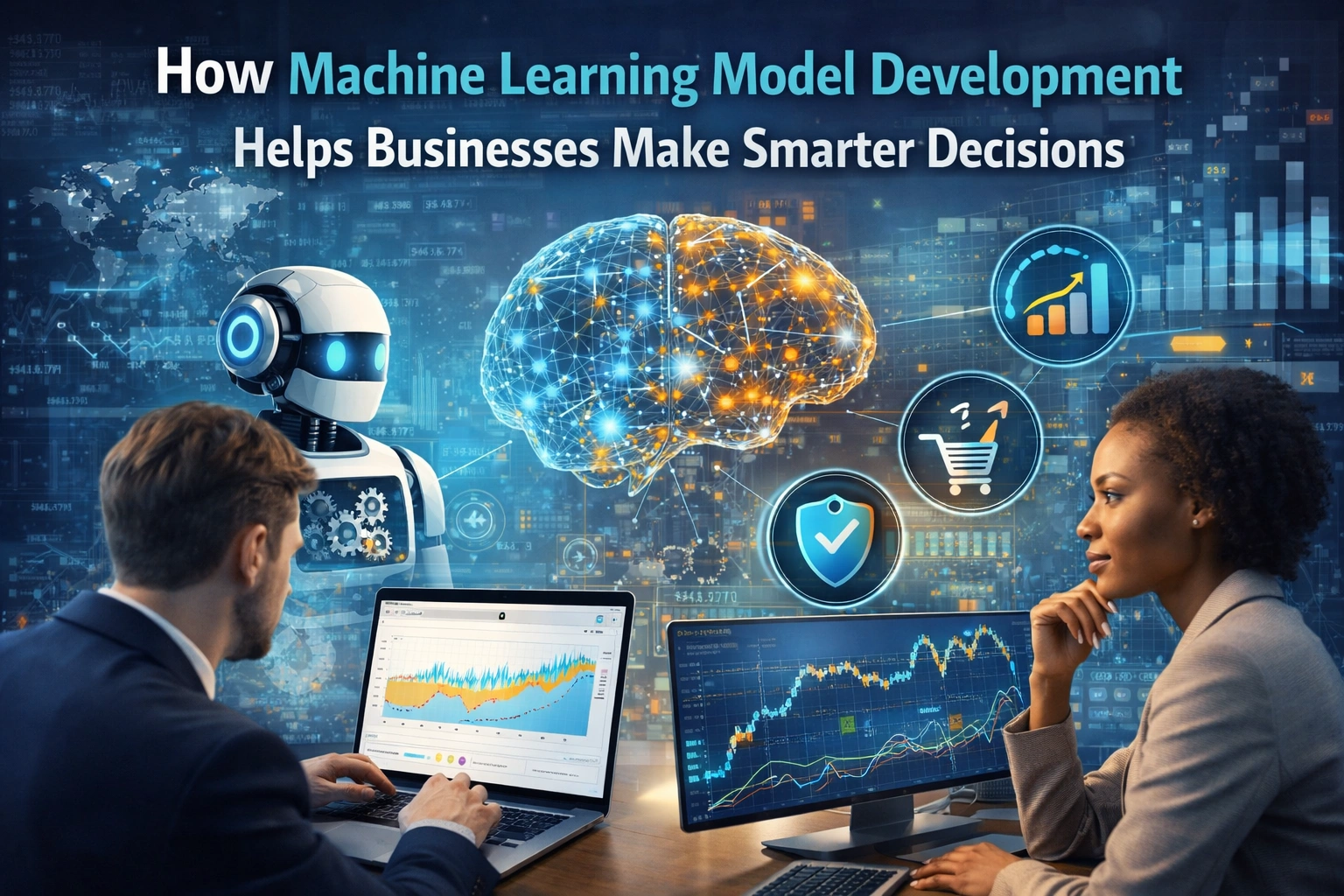
Businesses today generate massive amounts of data every day. However, having data alone is not enough. The real challenge lies in transforming that data into actionable insights that drive smarter decisions. Many companies struggle with slow analysis, inaccurate forecasting, and missed opportunities due to limited data utilization.
Machine learning model development solves this problem by enabling systems to analyze data, identify patterns, and predict outcomes. As a result, businesses can make faster, more accurate, and data-driven decisions that improve performance and reduce risks.
What Is Machine Learning Model Development and Why It Matters
Machine learning model development is the process of creating algorithms that learn from data and improve over time without being explicitly programmed. These models analyze historical and real-time data to generate predictions and insights.
This matters because modern businesses operate in dynamic environments where quick decisions are critical. Traditional analysis methods often fail to keep up with the speed and complexity of data. Machine learning fills this gap by offering automated, scalable, and intelligent decision-making support.
Moreover, it helps businesses move from reactive strategies to proactive planning, giving them a strong competitive advantage.
5 Ways Machine Learning Helps Businesses Make Smarter Decisions
1. Accurate Data Analysis and Insights
Machine learning processes large datasets quickly and efficiently. It identifies hidden patterns and correlations that humans may overlook.
This leads to more accurate insights, helping businesses understand customer behavior, market trends, and operational performance.
Key advantages include:
- Faster data processing
- Deeper insights
- Improved reporting accuracy
2. Predictive Decision Making
One of the biggest strengths of machine learning is prediction. Models can forecast future outcomes based on historical data.
For example, businesses can predict:
- Customer demand
- Sales trends
- Inventory requirements
- Market fluctuations
As a result, companies can make proactive decisions instead of reacting to problems after they occur.
3. Risk Reduction and Fraud Detection
Machine learning helps identify risks by analyzing unusual patterns and anomalies. This is especially useful in finance, cybersecurity, and operations.
It can detect:
- Fraudulent transactions
- System vulnerabilities
- Operational risks
By identifying risks early, businesses can prevent losses and improve security.
4. Personalized Customer Experiences
Machine learning enables businesses to deliver personalized experiences by analyzing customer preferences and behavior.
For instance, it can:
- Recommend products
- Customize marketing campaigns
- Improve user experiences
This not only improves customer satisfaction but also increases conversion rates and revenue.
5. Continuous Learning and Improvement
Unlike traditional systems, machine learning models improve over time. As they receive more data, their accuracy and performance increase.
This means businesses benefit from:
- Continuous optimization
- Better long-term decision-making
- Adaptive strategies
Over time, this leads to stronger business outcomes and sustained growth.
Use Cases of Machine Learning Model Development
Machine learning is widely used across industries to enhance decision-making processes. Its flexibility allows businesses to apply it in multiple areas.
Common use cases include:
- Finance: Credit scoring, fraud detection, and risk analysis
- Retail: Demand forecasting and recommendation systems
- Healthcare: Predictive diagnostics and patient care optimization
- Marketing: Customer segmentation and campaign optimization
- Supply Chain: Logistics planning and inventory optimization
These applications demonstrate how machine learning transforms data into strategic business value.
Why Businesses Need Machine Learning Model Development
Businesses that rely on manual analysis or outdated tools often struggle to keep up with fast-changing markets. Decision-making becomes slower and less accurate, leading to missed opportunities.
Machine learning addresses these challenges by providing real-time insights and predictive capabilities. It empowers businesses to act quickly, reduce uncertainty, and improve efficiency.
Additionally, companies that adopt machine learning gain a competitive edge. They can innovate faster, optimize operations, and deliver better customer experiences.
Conclusion
Machine learning model development is a powerful tool for smarter business decision-making. By analyzing data, predicting outcomes, and reducing risks, it enables companies to operate more efficiently and strategically.
Businesses that invest in machine learning are better positioned to adapt to change and achieve long-term growth. As data continues to grow, the ability to turn it into actionable insights will define success in the digital age.
If your organization wants to make smarter, faster, and more reliable decisions, machine learning model development is the solution to explore.